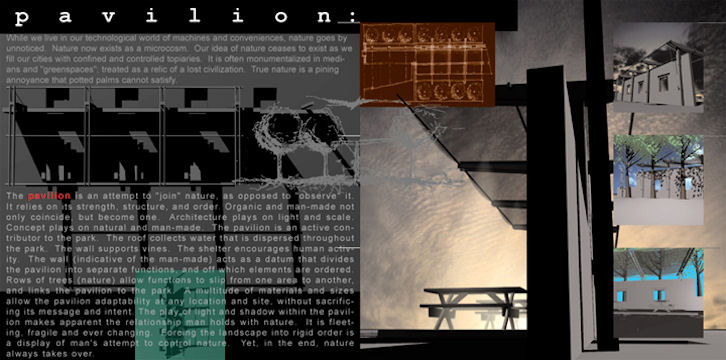
While we live in our technological world of machines and conveniences, nature goes by unnoticed. Nature now exists as a microcosm. Our idea of nature ceases to exist as we fill our cities with confined and controlled topiaries. It is often monumentalized in medians and “greenspaces”; treated as a relic of a lost civilization. True nature is a pining annoyance that potted palms cannot satisfy.
The pavilion is an attempt to “join” nature, as opposed to “observe” it. It relies on its strength, structure, and order. Organic and man-made not only coincide, but become one. Architecture plays on light and scale. Concept plays on natural and man-made. The pavilion is an active contributor to the park. The roof collects water that is dispersed throughout the park. The wall supports vines. The shelter encourages human activity. The wall (indicative of the man-made) acts as a datum that divides the pavilion into separate functions, and off which elements are ordered. Rows of trees (nature) allow functions to slip from one area to another, and links the pavilion to the park. A multitude of materials and sizes allow the pavilion adaptability at any location and site, without sacrificing its message and intent. The play of light and shadow within the pavilion makes apparent the relationship man holds with nature. It is fleeting, fragile and ever changing. Forcing the landscape into rigid order is a display of man’s attempt to control nature. Yet, in the end, nature always takes over.
awards
- YAF – Park Pavilion Competition – 1999